Your brain has a processing limit. At any given moment, information is arriving at some rate — notifications, headlines, messages, conversations, background noise — and your brain is working to make sense of it. When the information arriving stays within what your brain can comfortably handle, something remarkable happens: you think well. You weigh evidence. You update your views when new facts emerge. You catch yourself when you're wrong. This is your brain at its best.
But when information starts arriving faster than you can process it, a switch flips.
Your brain doesn't shut down. It doesn't slow down. It does something more subtle and far more dangerous: it hands control to a faster, cheaper, less accurate system. One that runs on pattern-matching and shortcuts instead of deliberate analysis. One that feels exactly like clear thinking from the inside — but isn't.
That handoff is not gradual. It behaves more like a tipping point. Your brain holds its ground until the pressure crosses a threshold, then tips rapidly. And the more stressed, sleep-deprived, or already overwhelmed you are, the lower that threshold sits and the faster the tip happens.
Once that switch has flipped, seven well-documented cognitive distortions activate — and intensify.
You start seeking information that confirms what you already believe, and filtering out anything that challenges it. You judge how common or dangerous something is based on how easily a vivid example comes to mind, rather than actual statistics. Your brain quietly swaps the hard question you were trying to answer for an easier one — without telling you. You assign far more weight to the most recent thing you encountered than it deserves. Whatever number, claim, or framing you heard first becomes the invisible reference point for every judgment that follows. You assess people and situations by how closely they resemble a mental prototype rather than by actual evidence — the mechanism behind snap social judgments and stereotyped decisions. And you respond to the way information is packaged rather than what it actually means — the same fact framed as a loss will hit you twice as hard as the same fact framed as a gain.
None of these seven distortions announce themselves. You don't feel biased when you're biased. You feel correct.
The critical insight is this: overload doesn't just make you tired. It acts as an amplifier. It takes the cognitive shortcuts that are always present at some low level in every human brain and turns them up. The higher the overload, the stronger the amplification. The stronger the amplification, the more distorted your perception becomes — and the less equipped you are to recognize that anything is wrong.
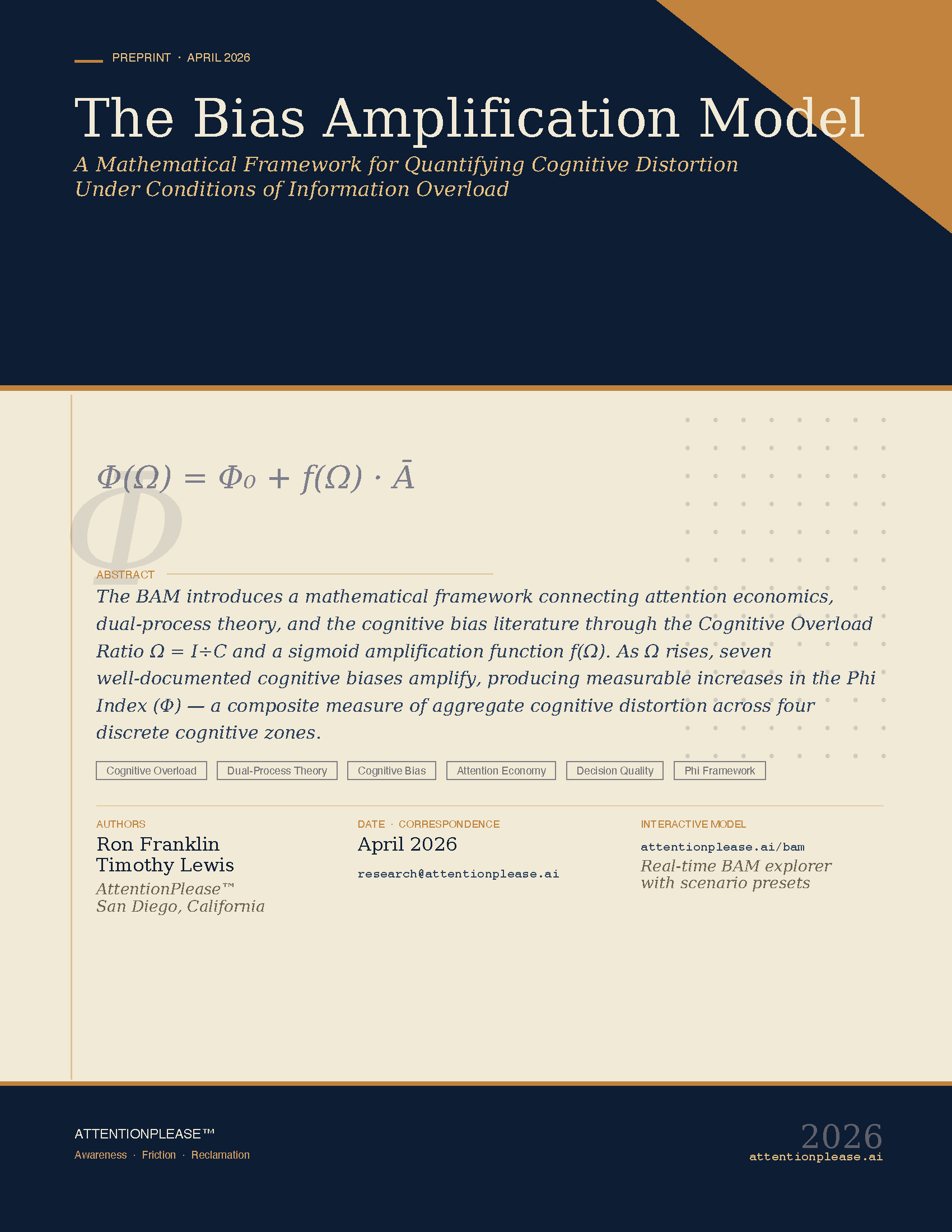
The model produces a single composite number representing your total cognitive bias state at any moment. At its floor, when information load is comfortably within your capacity, that number sits near its irreducible human baseline — a small, manageable level of bias that simply comes with being human. As overload increases, that number rises: first into moderate distortion, then significant distortion, then into the range where what you experience as obvious truth is not reliable. This is the state that social media algorithms are specifically engineered to keep you in, because engagement is highest when the amplifier is running hardest.
The good news — and this is the reason the model exists — is that overload is a ratio, not a fixed condition. It has two sides. You can reduce what's coming in. And you can build the capacity to process more. Both levers are real. Both respond to deliberate choices. And understanding the mechanism is the first step to using them.